

The “Rural Perspectives” seminars aim to foster discussion of doctoral research focusing on a range of pioneering experiments, which have been inventoried beforehand based on the issues they raise. Following this approach, no single issue will be emphasized or used as a prerequisite for participation. Instead, groups of issues and objects of study are collectively identified to program the seminar, determine the venue for each session, and assign instructors to coordinate the program.
Two seminars are planned per year.
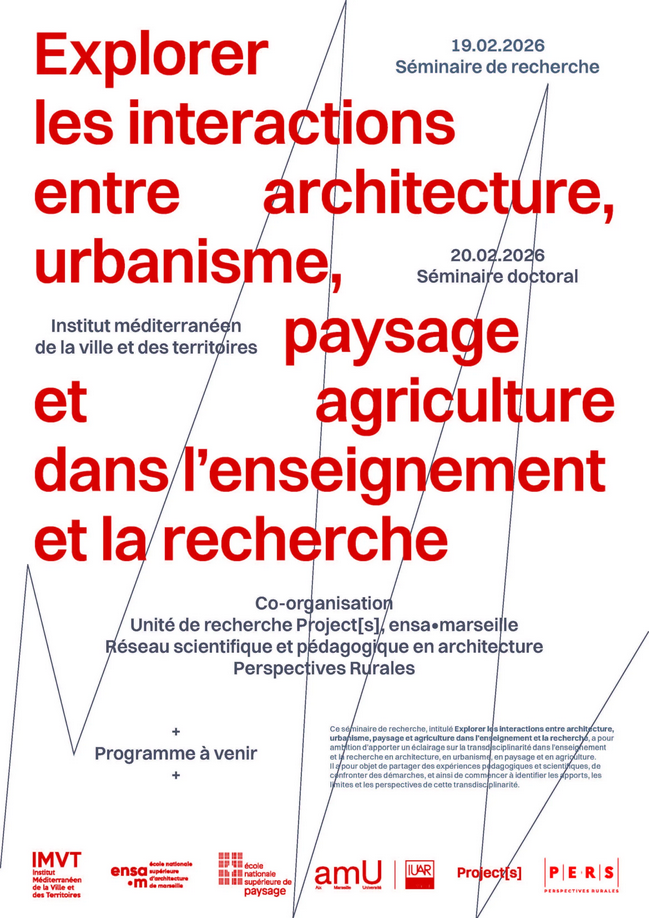
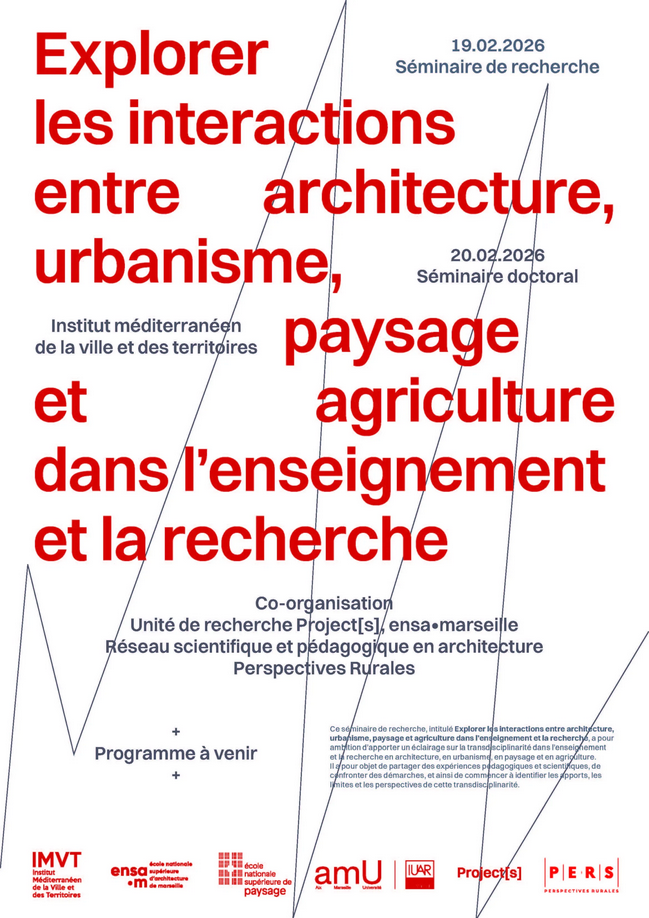
The first doctoral seminar is scheduled for February 19 and 20, 2026, at ENSA Marseille.
Background
In September 2023, the Mediterranean Institute of Cities and Territories (IMVT) opened its doors, bringing together students of architecture, urban planning, and landscape architecture under one roof. For the first time in France, teaching and research in these three disciplines share a common workspace, allowing them to showcase the transdisciplinary nature of their knowledge in the field of spatial design and planning. This collaboration presents a remarkable opportunity to address the evolving challenges of ecological, social, and economic transitions.
In this context, this seminar, organized by the Project[s] research unit of the ENSA Marseille and the Perspectives rurales scientific and educational network, will provide an opportunity to explore a crucial issue for study and project development: agriculture, taking into account the various practices emerging within the context of this transition.
Its aim is to shed light on transdisciplinarity in teaching and research in architecture, urban planning, landscape architecture, and agriculture. Its objective is to share pedagogical and scientific experiences : to compare approaches and to establish an initial overview of initiatives undertaken in educational institutions associated with these disciplines. The event also seeks to identify the contributions, limitations, and future prospects of this transdisciplinarity by bringing together teacher-researchers and doctoral students from these different disciplinary fields. The goal is to create a common foundation for reflection and resources for educational institutions and laboratories, which will be presented in the form of a collective work.
Observations
In cities and peri-urban areas, the emergence and spread of agricultural practices have led to the development of new types of agro-urban, agro-architectural, and agro-landscape projects, largely due to their status, which extends beyond simply providing food. These projects integrate social, economic, and educational considerations, resulting in new forms of spatial interaction. Similarly, in rural areas, we observe the deployment of new agricultural practices that contribute to a renewal of settlement patterns, aiming to implement new forms of subsistence outside of dominant economic flows.
This dynamic on the ground is widely reflected in architecture, urban planning, and landscape design, particularly in final-year projects and dissertations that deal directly or indirectly with agriculture. Students and teachers now share a common and growing interest in this subject. Together, they envision new ways of implementing human and non-human habitats capable of integrating food security while also addressing the multiple ecological and economic challenges this issue represents. Based on this observation, two sets of questions concerning the interactions between architecture, urban planning, landscape, and agriculture are identified in order to foster dialogue between these different disciplines and their representatives.
First register
In schools of architecture, urban planning, and landscape architecture, despite the growing interest in agriculture within design education, the knowledge imparted (new practices, ecological challenges, economic constraints, land realities, etc.) remains limited.
This knowledge is based more on intuition than on the acquisition of grounded expertise. Generally, agriculture occupies a marginal place in teaching and research programs, unlike other issues identified as drivers of ecological transition, such as bio-based materials, bioclimatic design, and climate-adapted plant palettes. Given this situation, it is legitimate to question how issues related to agriculture could be better integrated into schools of architecture, urban planning, and landscape architecture.
Specifically, what types of knowledge and expertise should be imparted, particularly beyond the role of food production? This is in order to highlight the multiple challenges that agriculture poses in light of the evolution of our ways of living in the management of natural resources and our relationship to living things.
Second register
Regarding higher education institutions specializing in agriculture, researchers in this field are currently working to produce a substantial database, drawing particularly on research conducted at institutions such as AgroParisTech and INRAE. Thus, echoing the observations mentioned above, it is also legitimate to ask what role and place this research gives to the spatial dimension of dwelling. How does it integrate, or fail to integrate, the spatial issues specific to architecture, urban planning, and landscape design? Indeed, given the significant differences in agricultural practices in urban, peri-urban, and rural areas (location, usable land area, land tenure, neighborly relations, access constraints, social issues, etc.), it seems appropriate to understand how connections are made with the spatial considerations of projects. In short, the question here is to understand how higher education institutions linked to agricultural education address topics specific to architecture, urban planning and landscape in their teaching and research.
Scientific Committee IMVT / PR / INRAE
- Alexandra BIEHLER, Landscape Architect, PhD in Geography, Co-Director of the Project[s] Research Unit, Senior Lecturer in Urban and Territorial Studies, ensa•marseille
- Xavier GUILLOT, Architect, PhD in Urban Planning and Development, Habilitation à Diriger des Recherches (HDR), Professor, ensa•marseille, Project[s] Laboratory
- Rémi JUNQUERA, Architect-Urban Planner, PhD in Architecture, Associate Researcher, Project[s], Part-time Lecturer, ensa•marseille
- Audrey MARCO, Landscape Architect, PhD in Plant Ecology, Lecturer-Researcher, ENSP, Larep
- Emmanuel MATTEUDI, Professor of Urban Planning and Development, Director of the LIEU Laboratory. IUAR
- Kristell Filotico, Architect, Lecturer at ensa•marseille
- Christine Aubry, Agricultural Engineer, PhD in Agronomy (AgroParisTech)
- Nadia Sbiti, Architect, PhD in Geography and Urban Planning, Lecturer in Urban and Territorial Studies (ENSA Toulouse)
February, 19th, 2026 • Participants in the research seminar
- Axelle Thierry, Landscape Designer and Architect, Lecturer at ENSA Normandie
Giulia Giacche, Agronomist and PhD in Spatial Planning, Research Fellow in Planning and Geography at INRAE
Antoine Petitjean, Architect-Urban Planner, Lecturer at the National School of Landscape Architecture of Versailles-Marseille
Jean Noël Consalès, Geographer-Urban Planner, Professor of Geography and Planning at Lumière University Lyon 2
Claire Aragau, Geographer and Professor at the Paris School of Urban Planning – Paris Est-Créteil University
Sophie Bonnin, Agricultural Engineer, PhD in Geography, Professor at ENSP Versailles
Colline Perrin, (Agro)Geography, Research Director in Geography at INRAE
Sylvie Salles, Architect, Professor of Landscape Design at the National School of Landscape Architecture
Alain Guez, Architect, Professor of Urban and Territorial Studies at
February, 20th, 2026 • Participants au séminaire doctoral
- Alessandra Miglio Co-directors: Sébastien Marot and Coline Perrin
Caroline Albinet Co-directors: Claire Delfosse and Adrien Baysse-Lainé
Guillaume Nicolas Director: Valéry Didelon
Sara Estanguet Co-directors: Rémi Papillault and Anaïs Leger-Smith
Félix Lacoin Co-directors: Sylvie Salles and Xavier Guillot Geoffrey Huguenin Co-directors: Xavier Guillot and Laurent Hodebert
Nathan Paris Co-directors: Xavier Guillot and Géraldine Casaux-Ginestet